
12 Outcomes. 49 Days. One Structural Shift.
Why businesses of every size are entering the same collision with reality

There is a dangerous assumption still dominating modern business thinking.
That the problems faced by:
startups
scale-ups
stagnant businesses
companies in crisis
businesses preparing for exit
…are fundamentally different.
Increasingly, they are not.
Beneath the surface, most businesses are colliding with the same structural issue:
They were built for growth.
Not investability.
This is becoming one of the defining business failures of the AI economy.
Because while private capital markets continue expanding globally, most businesses remain structurally underprepared for the level of scrutiny, predictability and professionalisation modern investors increasingly require.
The result is extraordinary.
A startup seeking survival funding.
A scale-up trying to accelerate growth.
A mature company struggling with stagnation.
A founder preparing for exit.
A business in operational crisis.
All often suffer from the same hidden weaknesses:
founder dependency
unpredictable cash flow
weak operational systems
low visibility
under-monetised intellectual property
poor pricing power
fragmented leadership
weak scalability
limited global relevance
hidden operational risks
The stage changes.
The structural problem often does not.
This is precisely why the High Valuation Triangle exists.
Not as a motivational framework.
But as a professionalisation architecture system designed for a rapidly changing capital environment.
And it is why the “12 Outcomes in 49 Days” framework matters far beyond finance.
The great misunderstanding about business growth
Most founders still believe valuation is created during fundraising.
It is not.
Valuation is engineered operationally long before investors arrive.
Sophisticated investors increasingly reward businesses capable of producing:
predictable economic behaviour
scalable systems
transferable leadership
visible cash conversion
durable customer lifetime value
operational resilience
monetisable intellectual property
In other words:
Businesses designed as systems rather than personalities.
The challenge is that most businesses only begin professionalising reactively:
when cash pressure appears
when scaling creates chaos
when investors demand visibility
when lenders lose confidence
when acquisition discussions begin
when operational complexity overwhelms leadership
By then, the valuation discount has often already begun.
Why every business size now faces the same pressure
One of the most dangerous myths in business is that professionalisation only matters for large companies.
In reality, the opposite may now be true.
Small businesses (<$5m revenue)
Often operate with:
founder-led sales
reactive forecasting
weak pricing discipline
under-monetised expertise
low operational visibility
The result is usually exhaustion disguised as entrepreneurship.
Medium businesses (<$20m revenue)
Frequently encounter:
scaling bottlenecks
management gaps
inconsistent customer experience
increasing working capital pressure
operational fragmentation
Growth begins amplifying weaknesses faster than strengths.
Larger businesses (>$20m revenue)
Face an entirely different danger:
institutional scrutiny.
At this level:
governance quality matters
operational replicability matters
debt capacity matters
reporting confidence matters
leadership scalability matters
Investors no longer tolerate improvisation.
And AI is accelerating this pressure dramatically.
The 12 outcomes are not goals. They are survival mechanisms.
The mistake many businesses make is viewing transformation as optional.
Increasingly, it is becoming mandatory.
The “12 Outcomes in 49 Days” framework was designed around one uncomfortable observation:
Every business eventually collides with the same valuation barriers.
The outcomes are therefore less about ambition and more about removing structural fragility.
Outcome 1: Become Bankable
A business without underwriting confidence eventually becomes trapped.
Bankability affects:
lending access
investor confidence
debt pricing
acquisition attractiveness
Many founders mistakenly believe profitability alone creates bankability.
It does not.
Predictability does.
Outcome 2: Master the 5 Layers of Intellectual Property
Most businesses radically under-monetise what they already know.
They protect intellectual property legally while failing to commercialise it strategically.
This becomes increasingly dangerous in the AI economy where knowledge itself is becoming scalable infrastructure.
Outcome 3: Revenue Without Founder Dependency
This may become one of the most important valuation drivers of the next decade.
Founder dependency creates fragility.
Transferability creates valuation.
Sophisticated investors increasingly ask one silent question:
“What happens if the founder disappears for 90 days?”
Many businesses struggle to answer honestly.
Outcome 4: Monetise AI
AI is not simply a productivity tool.
It is becoming a valuation amplifier.
Businesses capable of turning AI into:
margin expansion
operational visibility
scalable delivery
monetisable systems
…will increasingly command disproportionate investor attention.
Outcome 5: Predictable Cash Flow
Perhaps the most misunderstood valuation driver in modern business.
Revenue does not create confidence.
Predictability does.
Businesses with visible, stable and forecastable cash behaviour become fundamentally easier to finance and scale.
Outcome 6: Eliminate Hidden Risks
Many businesses do not fail because risks exist.
They fail because risks remain invisible until capital events expose them.
Investors increasingly pay premiums for operational transparency.
Outcome 7: Create Pricing Power
Businesses competing on price rarely command premium valuation multiples.
Pricing power reflects:
market positioning
intellectual property
customer trust
operational maturity
In many cases, pricing reveals valuation quality more accurately than revenue itself.
Outcome 8: Engineer Capital Strategy
Many businesses accidentally structure themselves into future dilution, weak financing or strategic limitation.
Capital strategy is no longer an accounting issue.
It is an architectural one.
Outcome 9: Scale Leadership
Operational scalability without leadership scalability eventually collapses.
Many businesses grow revenues faster than management capability.
That gap quietly destroys enterprise value.
Outcome 10: Become Globally Relevant
AI and digital infrastructure are reducing the advantages of geographic limitation.
Businesses designed only for local survival increasingly struggle to command premium valuations.
Global relevance changes investor perception dramatically.
Outcome 11: Systemise Operations
This is where many businesses quietly break.
Without systems:
complexity increases
visibility deteriorates
forecasting weakens
founder dependency rises
customer experience fragments
Growth without operational systemisation often becomes chaos disguised as progress.
Outcome 12: Attract Capital
This is the final outcome most founders mistakenly place first.
Capital attraction is usually the consequence of professionalisation.
Not the starting point.
The businesses investors pursue aggressively are rarely accidental.
They are structurally investable.
Why this matters now more than ever
The AI economy is changing the rules of valuation faster than many businesses realise.
In previous decades, operational weaknesses could remain hidden beneath growth.
Today:
AI exposes inefficiency
investors demand predictability
lenders require visibility
customers expect consistency
capital markets reward resilience
This is creating a profound divide between businesses designed for momentum and businesses designed for durability.
The winners of the next decade may not necessarily be the fastest growing.
They may simply be the most structurally professionalised.
That is the real purpose behind the High Valuation Triangle.
And it is precisely why I developed the “12 Outcomes in 49 Days” framework.
Not to create motivational content.
But to help businesses at every stage:
become bankable
improve predictability
scale leadership
monetise intellectual property
strengthen customer lifetime value
increase valuation resilience
operate with institutional credibility
Because the future may belong less to businesses that grow aggressively —
and more to businesses sophisticated enough to remain investable when complexity arrives.
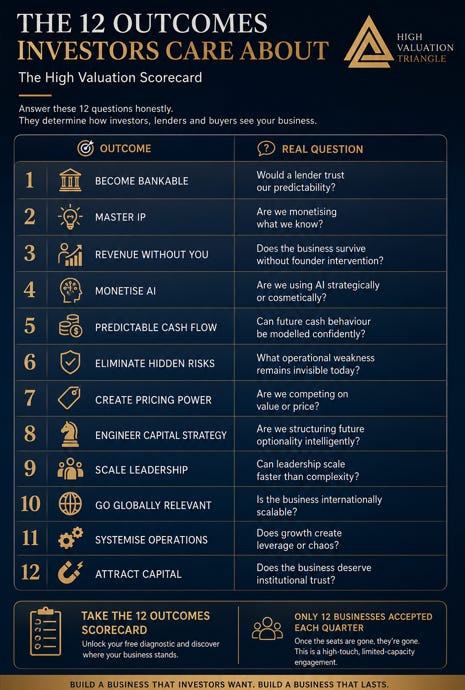
The 12 Outcomes Cheat Sheet
Save this. Revisit it quarterly.
And that may ultimately be the defining business question of the AI era.
The 12 Questions Every Business Should Ask
Would a lender trust our predictability?
Can the business survive without founder intervention?
Is our intellectual property monetised or merely protected?
Are we using AI strategically or cosmetically?
Can future cash behaviour be forecast confidently?
Which hidden operational risks remain invisible today?
Are we competing on value or price?
Is our capital structure helping or limiting future optionality?
Can leadership scale faster than complexity?
Could this business operate globally without reinvention?
Does growth create leverage or operational chaos?
Does the business genuinely deserve institutional trust?
Most businesses avoid these questions.
Sophisticated investors do not.
The real urgency
The danger is that many founders still believe professionalisation can happen later.
After fundraising.
After growth.
After expansion.
After crisis.
Increasingly, that assumption may become fatal.
Because AI is accelerating scrutiny faster than businesses are improving structurally.
Weaknesses once hidden for years are now visible almost immediately.
This means the next decade may reward a completely different type of business.
Not merely ambitious businesses.
But structurally investable businesses.
A private invitation
Over the next quarter, only 12 businesses will be accepted into the High Valuation Triangle diagnostic and implementation process.
Why only 12?
Because genuine transformation requires depth, not volume.
Each participating business will receive:
a full 12 Outcomes scorecard assessment
a personalised diagnostic
identification of hidden valuation gaps
analysis of bankability and predictability
investor-readiness insights
operational and leadership observations
strategic recommendations linked directly to valuation potential
The diagnostic is currently offered free to selected businesses.
But once the 12 quarterly seats are filled, applications will close until the following quarter.
Because the businesses most likely to dominate the AI economy will not necessarily be the loudest.
They will be the most structurally prepared.
And that preparation window is beginning to narrow.
If you want to assess where your business truly stands across the 12 Outcomes, you can apply for the diagnostic and scorecard assessment connected to the High Valuation Triangle framework and Fail. Pivot. Scale..
The future may not belong to businesses that simply grow.
It may belong to businesses sophisticated enough to deserve capital.
Take the scorecard below
If you are a solopreneur, here is a special 12-outcome scorecard
About Matteo Turi FCCA
I have spent more than three decades working across businesses at almost every stage of complexity:
startup
scale-up
stagnation
turnaround
fundraising
international growth
crisis
exit preparation
My career has included CFO, Board Director and strategic advisory roles across industries where one uncomfortable pattern kept repeating itself:
Many businesses work extremely hard to grow, yet very few are designed to become truly investable.
That observation eventually led to the creation of the High Valuation Triangle.
A framework built around three structural pillars:
intellectual property monetisation
succession planning and scalable leadership
global relevance
The framework was developed to help businesses move away from reactive growth and toward engineered valuation.
Because increasingly, the market rewards businesses that can produce:
predictability
scalability
transferable execution
operational maturity
durable customer economics
institutional confidence
Not simply ambition.
Over time, this work evolved into the “12 Outcomes in 49 Days” methodology, designed to help businesses identify the structural gaps that often prevent:
bankability
premium valuation multiples
investor readiness
predictable cash flow
scalable leadership
operational resilience
The goal is not motivational theory.
It is business professionalisation.
Because the next decade may reward structurally investable businesses far more aggressively than businesses merely chasing growth.
About Fail. Pivot. Scale.
Fail. Pivot. Scale. was written to explain a shift that many businesses still fail to see clearly.
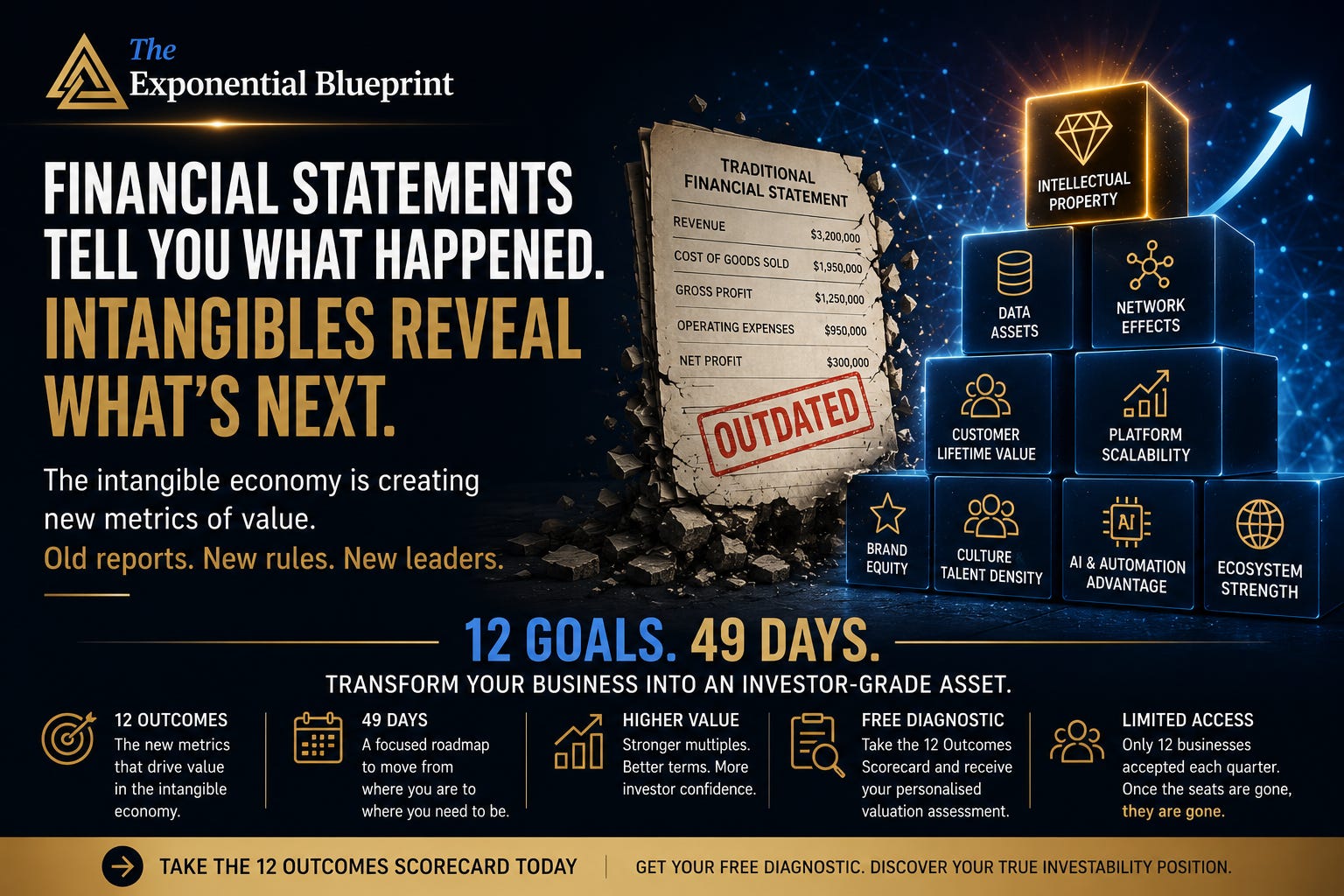
We are moving from an economy where value was primarily measured through physical assets and historical financial reporting…
…to one where value increasingly comes from:
intellectual property
systems
data
customer economics
operational predictability
AI integration
leadership scalability
ecosystem positioning
future cash visibility
Traditional financial statements still matter.
But increasingly, they explain what happened yesterday.
Modern valuation increasingly rewards what is likely to happen tomorrow.
That is why the book focuses heavily on:
valuation architecture
bankability
professionalisation
predictability
AI-driven operational change
investor psychology
the invisible drivers of premium valuation multiples
At its core, the book asks one central question:
Why do some businesses become magnets for capital while others remain trapped in operational pressure despite growth?
That question may become one of the defining business questions of the AI economy.
And it is precisely why the High Valuation Triangle and the 12 Outcomes framework exist today.