
The Invisible Valuation Gap
Why AI, intangible assets and $10 trillion of capital are separating companies that generate revenue from those designed to generate valuation.

A structural shift is underway in the global economy. Artificial intelligence, intangible assets and a $10 trillion expansion of private capital are quietly redrawing the rules of valuation. Companies that adapt will see value compound. Those that delay may see value disappear.

Most businesses believe they are building value.
In reality, they are building revenue.
Those two things are not the same.
Revenue proves a business works.
But valuation emerges from architecture.
In the coming decade, the companies that attract capital will not necessarily be the ones that grow the fastest.
They will be the ones designed to transform knowledge into intellectual property, leadership into scalable systems and markets into global opportunity.
Revenue proves a business works.
Architecture proves a business is worth buying.

The New Economics of Business Value
February 2026 offered several signals about the direction of the global economy.
They did not appear as a single dramatic headline. They emerged as fragments.
A wave of corporate restructurings.
A surge in artificial intelligence investment.
And renewed momentum in capital markets.
Consider one example.
Fintech group Block recently announced plans to eliminate roughly four thousand roles as the company restructures around artificial intelligence and new operating models. The decision reflects a broader pattern. Organisations across technology, finance and professional services are redesigning themselves around automation and software-driven productivity.
At the same time, corporations are committing enormous capital to artificial intelligence infrastructure.
Billions of dollars are flowing into data centres, machine learning platforms and computational networks capable of supporting the next generation of digital services.
Meanwhile, capital markets are expanding rather than contracting.
Global investment banking revenues have risen sharply as mergers, acquisitions and public offerings accelerate again. Private markets continue to accumulate extraordinary resources. Analysts estimate that roughly ten trillion dollars of additional private capital may enter global markets by the end of this decade.
Taken individually, these developments are significant.
Taken together, they represent something larger.
The economic architecture of modern companies is being rewritten.
Artificial intelligence is reshaping productivity.
Intangible assets now represent roughly ninety per cent of the value of the S&P 500.
An unprecedented pool of capital is searching for scalable businesses capable of absorbing investment.
The implication is simple.
Capital is no longer scarce.
Scalable architecture is.
And that imbalance is producing a phenomenon many companies have not yet recognised.
The Invisible Valuation Gap
Two companies can generate identical revenue.
Yet one may be valued at ten times the other.
This gap rarely appears in financial statements. It becomes visible only when investors arrive.
Imagine two companies generating five million euros in annual revenue.
The first relies heavily on founder expertise and manual service delivery. Revenue grows through operational effort.
The second owns proprietary technology, intellectual property and scalable systems capable of expanding without proportional increases in labour.
To customers, the companies may appear similar.
To investors, they represent entirely different assets.
One is an operating business.
The other is a scalable platform.
This distinction creates what I describe as the Invisible Valuation Gap.
The gap is invisible because it does not appear directly in accounting metrics. It becomes painfully visible the moment a company attempts to raise capital.
Converting Innovation Into Enterprise Value
Over the past months, I have begun working with a deep technology company facing this challenge precisely.
The organisation had developed a sophisticated electro-physical technology supported by intellectual property and engineering expertise.
The innovation was impressive.
But technology alone rarely determines valuation.
Investors ultimately price something different. They price the degree to which technology can be transformed into predictable economic value.
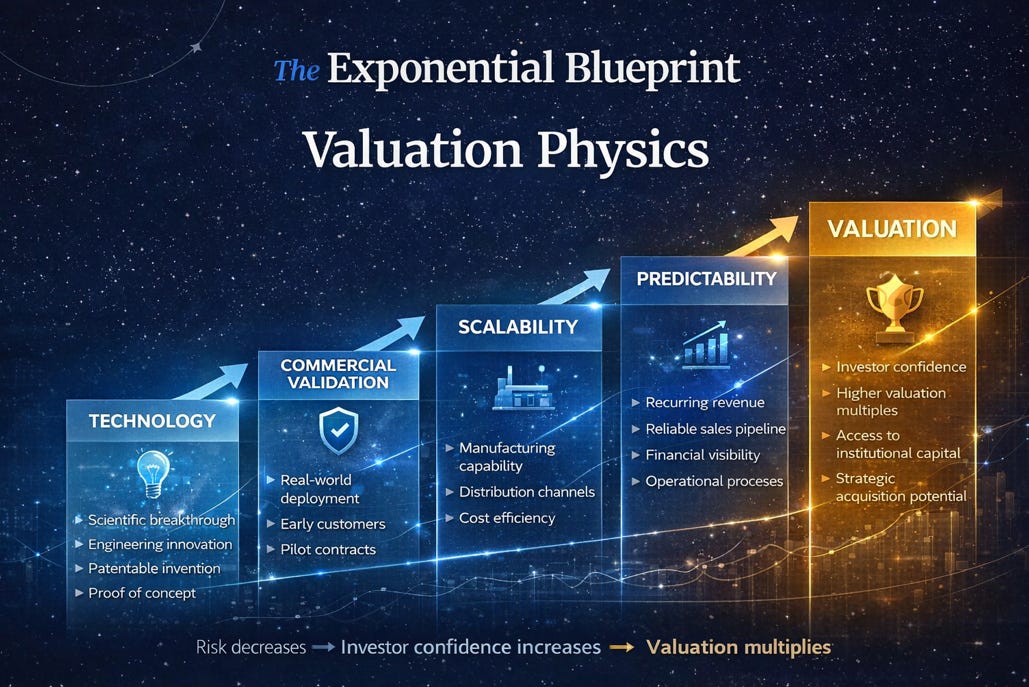
In practice, this transformation follows a sequence I describe as valuation physics.
Technology is only the first stage.
From there, the company must demonstrate commercial validation, scalability, and predictable revenue before investors apply stronger valuation multiples.
The process therefore, becomes one of systematically removing risk.
First, the technology must be validated outside the laboratory.
Then, intellectual property protection must be secured across relevant markets.
Then, commercial demand must be demonstrated through real customers rather than grants or experiments.
Then production and operational scalability must be proven.
Finally, the company must build a financial architecture that translates operational progress into credible investor narratives.
Each step removes uncertainty.
And every reduction in uncertainty increases investor confidence and, therefore, valuation potential.
Many companies remain undervalued not because their technology is weak but because their architecture remains incomplete.
The Moment Companies Realise
One of the most interesting moments in this process occurs when founders recognise the difference between innovation and valuation.
Innovation creates possibility.
Valuation emerges when that possibility becomes economically predictable.
For the company, we recently began advising the question quickly became clear.
Was its current valuation the arrival point?
Or was it merely the starting point?
The answer depends entirely on the architecture built before capital markets become involved.
Why Timing Matters
The urgency of this transformation cannot be overstated.
Artificial intelligence is rewriting productivity across industries.
Intangible assets now dominate corporate balance sheets.
Private capital is expanding faster than at any previous point in modern financial history.
These forces create a simple but unforgiving dynamic.
Companies that adapt early will see their valuation compound.
Companies that delay may discover that their value quietly erodes as markets move ahead of them.
Markets rarely reward hesitation.
A Harsh Truth
Many companies believe they are preparing to raise capital.
In reality, they are preparing to explain why they are not ready.
Investors do not fund potential alone.
They fund de-risked potential.
This is why the most successful capital raises rarely begin with fundraising itself.
They begin with architecture.
The Blueprint Explained
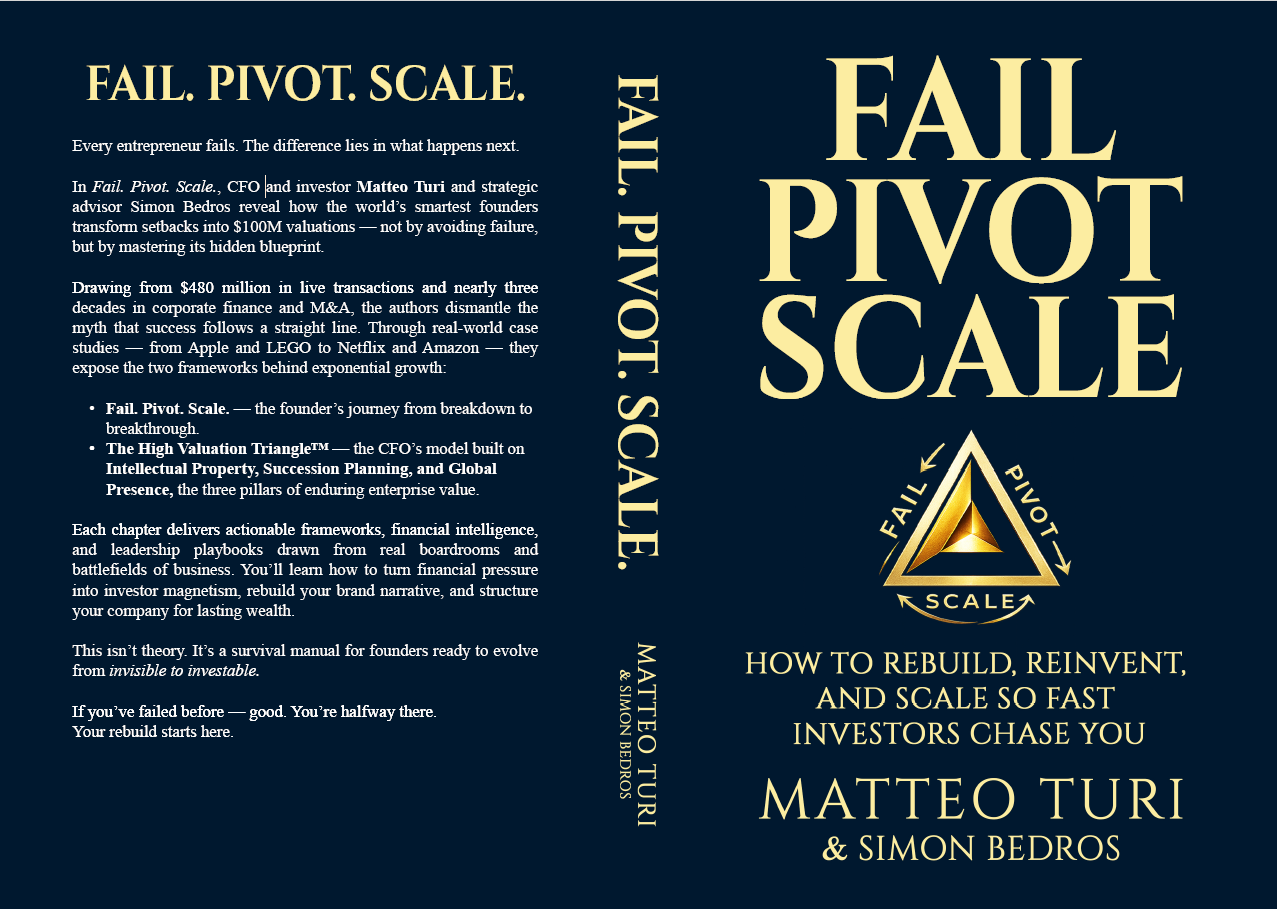
These structural dynamics form the foundation of my book Fail. Pivot. Scale.
The book explores how organisations evolve from fragile operating businesses into investable enterprises capable of attracting capital and scaling internationally.
Several industry leaders have captured the shift clearly.
One reviewer described the “book as a blueprint for modern companies operating in an intangible economy.”
Another observed that “the framework reframes finance from reporting the past to engineering the future.”
The central message is straightforward.
Companies that understand the architecture of valuation early gain an extraordinary strategic advantage.
High Valuation Sessions
For founders and leadership teams currently navigating these dynamics, I have begun offering a limited number of High Valuation Sessions.
These sessions follow the same analytical process used in the advisory work described above.
Together we examine
Intellectual property defensibility
Commercial validation
Operational scalability
Financial architecture and investor readiness
The company’s position within the Invisible Valuation Gap
The objective is simple.
To determine whether the current structure of the company is designed to attract capital or repel it.
If you are preparing for growth, investment or international expansion you can request a High Valuation Session.
Editorial Closing
The next decade will not reward growth alone.
It will reward structural clarity.
Artificial intelligence will continue accelerating productivity.
Intangible assets will continue dominating corporate value.
Private capital will continue searching for scalable companies capable of absorbing investment.
But these forces will favour organisations built with deliberate architectural design.
The companies that thrive will not necessarily be those that work the hardest.
They will be those who recognise the Invisible Valuation Gap early and redesign their structures before capital arrives.
Once the market recognises the gap, it rarely closes it.
The Valuation Series
This article is part of The Valuation Series, a biweekly exploration of how businesses transition from revenue generation to valuation creation.
Upcoming editions will explore
Why investors buy architecture rather than revenue
The intellectual property advantage
Founder dependency as a hidden valuation killer
The global optionality effect
Artificial intelligence and the valuation reset
Fail. Pivot. Scale.
Fail. Pivot. Scale is not a slogan.
Fail. Pivot. Scale is a cycle.
It is a cycle we all encounter in our life.
The book shows how the High Valuation Triangle will create businesses that are chased by customers, banks and investors.
Matteo Turi
Chartered Accountant
CFO and creator of the High Valuation Triangle
Founder of the Exponential Blueprint
Helping organisations move from invisible to investable.
Nice!